Why One Tool Is Never Enough
Homeowners often ask why we walk through with two devices and a tablet instead of just pointing a thermal camera at the wall. The honest answer is that infrared imaging and moisture metering measure two very different things, and the value comes from comparing them. Thermal cameras detect surface temperature. Wet materials are typically cooler than surrounding dry materials because evaporation pulls heat away, but that relationship breaks down in plenty of real world situations. A sun warmed exterior wall, a recently used dishwasher, a cold water supply line, or a poorly insulated cavity can all create thermal signatures that look like water and are not. Meanwhile, a saturated subfloor under tile may show almost no thermal contrast because the tile masks the temperature differential.
This is where the mapping discipline matters. We grid the affected area, take a thermal sweep to identify anomalies, then verify every suspicious reading with a pin meter for drywall and wood or a non invasive sensor for tile and stone. The numbers go onto a floor plan with timestamps. That map becomes the basis for placing air movers and dehumidifiers, and it becomes the document we share with your insurance carrier. If you want a deeper look at how this connects to signs of hidden water damage in your home, our detection guide walks through the warning signs that should prompt this kind of scan.
The environmental context matters too. Before any scan, our technicians log ambient temperature, relative humidity, and the dew point in each affected room. A thermal camera reading taken in a 60 degree basement behaves very differently from one taken in a sun drenched upstairs bedroom, and without those baseline numbers the imagery can mislead. McCordsville Water Restoration technicians treat the first ten minutes of any McCordsville call as data collection, not demolition. That discipline is what makes the rest of the job defensible.
Thermal Imaging vs Moisture Meters vs Visual Inspection
The table below shows how each method performs across the situations we encounter most often in McCordsville homes. Read it as a guide to why we layer methods rather than relying on one.
| Scenario | Visual Inspection | Thermal Imaging | Moisture Meter | Combined Mapping |
|---|---|---|---|---|
| Water behind painted drywall | Misses early stages | Shows cool anomaly if active | Confirms moisture content | Locates and quantifies |
| Saturated subfloor under tile | No visible sign | Weak signal through tile | Non invasive sensor flags it | Maps full footprint |
| Wet insulation in exterior wall | Invisible | Strong cool signature | Requires small probe access | Targets controlled openings |
| Ceiling leak from above | Stain visible only after drying | Reveals migration path | Confirms wet vs cosmetic | Identifies source direction |
| Concrete slab moisture | Possible darkening | Shows cool zones | Calcium chloride or RH probe needed | Differentiates active vs residual |
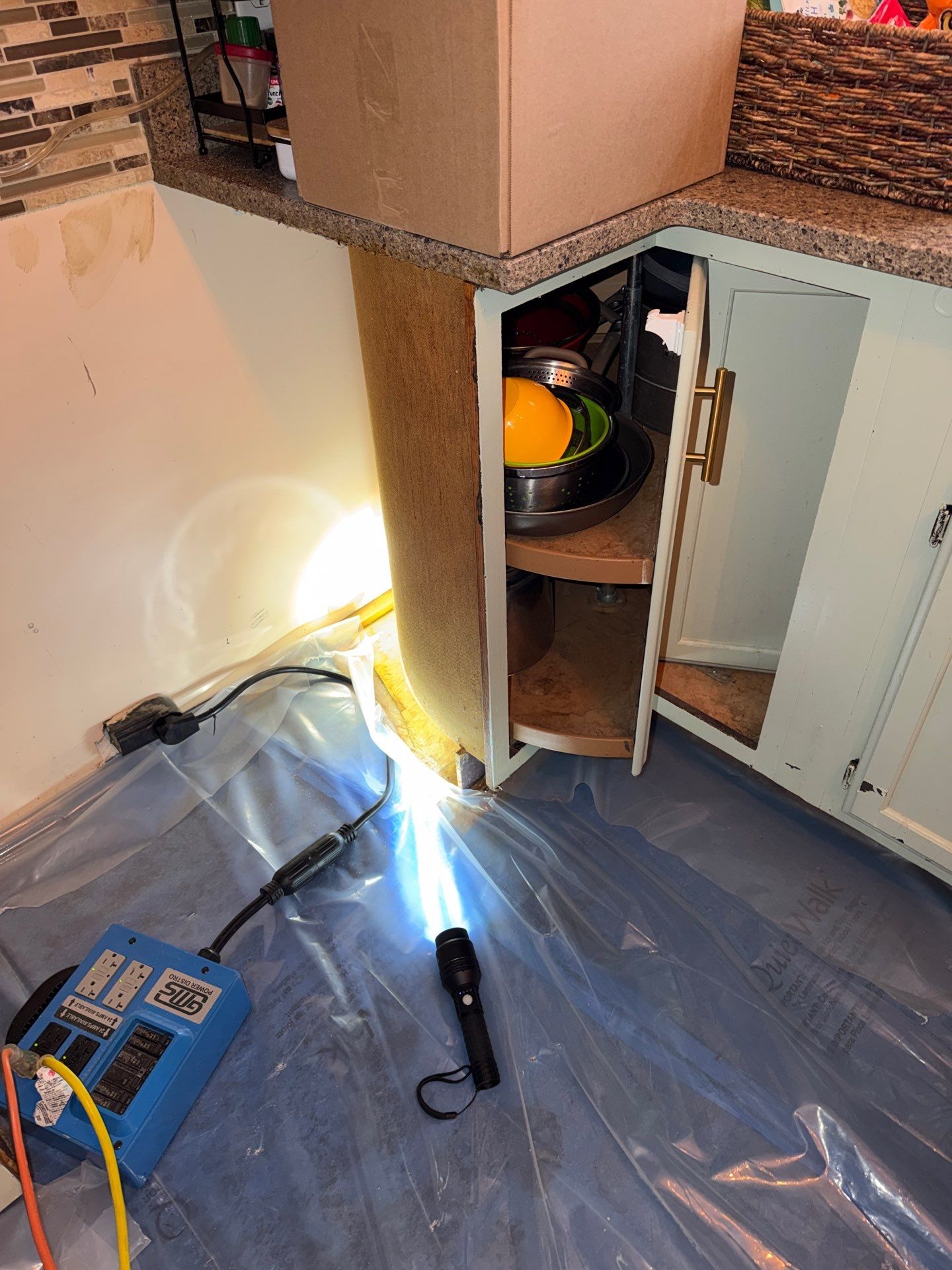
| Cabinet toe kick water | Hidden by trim | Cool line at base | Confirms behind kick plate | Decides removal vs in place dry |
| HVAC condensate damage | Stains near vents | Pattern follows airflow | Verifies extent in drywall | Distinguishes from roof leak |
| Documentation for claim | Photos only | Color coded imagery | Numeric readings | Full evidence package |
What the Map Actually Tells Us
Once the moisture map is complete, the drying strategy almost writes itself. Wet insulation in an exterior cavity changes the equation entirely. We may need controlled openings, sometimes called flood cuts, to access and dry the cavity rather than trapping moisture behind a vapor barrier. A saturated subfloor with dry surface flooring tells us we need negative pressure systems or specialized mat extraction rather than just air movers blowing across the top. If the thermal signature shows water tracking down a stud bay from a second floor source, we know the real problem is two rooms away from where you noticed the stain. The map drives the equipment list, the dry time estimate, and the demolition scope.
This is also where moisture mapping protects you from over demolition. Some contractors remove drywall by default. Our standard is to remove only what readings prove is unsalvageable, and to dry in place wherever the science supports it. The same data set tells us when material has to come out. If you are weighing how aggressive the scope should be, our breakdown of how much drywall has to come out after water damage explains the thresholds we use.
The map also has financial weight. Insurance adjusters increasingly expect thermal imagery alongside meter logs, and a clean evidence package shortens the back and forth that delays payment. When a claim is contested, the existence of timestamped readings from day one is often the deciding factor. We have seen McCordsville homeowners recover thousands more on legitimate claims simply because the documentation left no room for argument about the extent of the loss or the necessity of the work performed.
Mapping Throughout the Drying Process
The first map is not the last map. We return daily during drying to remap moisture content and verify that readings are trending down toward the dry standard for each material type. Wood framing, gypsum, concrete, and engineered flooring all have different target moisture contents, and the only way to confirm we have reached them is to measure. A thermal sweep at day three may show that one zone is lagging, which lets us reposition equipment before it becomes a problem. This iterative approach is what separates a documented restoration from a guess, and it ties directly into the water damage dry out timeline you should expect.
Daily remapping also catches secondary issues that the first scan could not predict. A dehumidifier running for 48 hours can pull moisture out of materials that initially read dry, revealing that water had migrated further than the original footprint suggested. Cooler overnight temperatures sometimes shift condensation patterns and expose a cavity that looked fine during the daytime scan. Each remap is a chance to refine the plan rather than commit to a scope that no longer fits the conditions in your home.
Our crews arrive in most cases within 2 hours of your call, and the assessment is free. We will show you the thermal images and the meter readings on the spot, explain what each anomaly means, and give you a written scope before any work begins. That transparency is non negotiable for us.